
When a utility damage occurs, the immediate focus shifts to determining what happened, how it happened, and who is responsible. Excavators, facility owners, locators, and investigators all begin piecing together the events that led to the incident while working to identify its root cause and prevent it from happening again
Unfortunately, investigators are often trying to reconstruct a scene that no longer exists. Once excavation begins, the jobsite starts to change.
That is why pre-excavation photography should no longer be viewed as a helpful suggestion or an optional precaution. It should become an industry best practice.
The newly published 2025 Common Ground Alliance DIRT Report reinforces why accurate investigations matter. More than 221,000 unique damage events were reported across the United States and Canada in 2025, and the ten most common root causes account for 86% of all reports with an identified cause.
The report also highlights a familiar reality: most of the same root causes continue to appear year after year, suggesting the industry still has opportunities to improve how incidents are understood and prevented.
While technologies, regulations, and training continue to evolve, many of the industry’s most persistent failure points remain the same. Breaking that cycle requires not only preventing incidents but learning from every one that occurs.
That learning process is dependent on quality evidence.
Every Jobsite Changes the Moment Work Begins
Excavation sites are constantly evolving. Paint markings fade or become altered. Marking flags get moved. Soil is displaced. Within minutes of breaking ground the jobsite no longer looks the way it did at the start of the day.
When investigators attempt to determine the root cause of a damage they are often forced to reconstruct events after much of the physical evidence has already changed.
Photographs and videos taken before excavation preserve that evidence.
Rather than relying on memory or conflicting accounts, investigators have an objective record showing site conditions before the first shovel entered the ground.
That record provides valuable context when evaluating locating accuracy, excavation practices, tolerance zones, existing site conditions, and other factors that contribute to a thorough root cause analysis.
Build a Complete Visual Record
Creating meaningful documentation does not require specialized equipment. A smartphone and a few extra minutes before work begins is all it takes to dramatically improve the quality of a future investigation.
A consistent documentation process should include:
Wide-angle photos showing the overall jobsite
Images from multiple directions to create a complete 360-degree view
Close-up photos of utility markings, flags, and white lining
Nearby landmarks, street signs, structures, and fixed reference points
Photos clearly showing the relationship between excavation activities and the tolerance zone
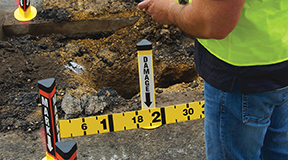
Using a damage investigation tool like the HitKit™ to stage the area and help establish perspective and space
Date and time stamped photos and videos to establish an accurate timeline
Together, these images tell a chronological story that cannot be recreated once excavation begins.
And while pre-excavation photography’s greatest value is improving the industry’s ability to understand what happened, it also provides excavators protection against false claims and fraud.
In one real-world example shared by Texas811’s Tina Sanders, an excavation crew was accused of putting a hole in a fence that led to a dog running away, and the homeowners were suing the excavation crew for the loss of their prized (and expensive) family dog.
However, pre-excavation photographs demonstrated the hole in the fence existed before excavation began, allowing investigators to establish the facts and have the family quickly withdraw their lawsuit.
While protecting contractors from false claims is certainly a benefit, the larger opportunity lies in improving the quality of every damage investigation.
The more accurately investigators can determine root causes, the better the industry can refine training, improve locating practices, strengthen excavation procedures, and reduce future damages.
Make Documentation Part of the Standard Process
The damage prevention industry has successfully transformed many practices that were once considered optional into everyday expectations. Calling 811 before digging, verifying locate marks, and exposing facilities safely are now recognized as essential steps in responsible excavation.
Pre-excavation photography deserves the same status.
When a damage does occur, documenting the incident with a structured investigation tool like the Hit Kit™ helps thoroughly document the scene after the impact, but those photos tell only part of the story. Pre-excavation photos provide the “before” picture, while damage investigation photos capture the “after.” Together, they create a complete visual timeline that allows investigators to reconstruct events with greater accuracy and confidence.
Whether crews use a smartphone or a standardized documentation process, consistency is what matters most. It’s a simple, low-effort step that will preserve evidence and improve the quality of every investigation, as well as potentially save your organization thousands of dollars.
The strongest damage investigations don’t begin after a utility is struck.
They begin before excavation ever starts.