DPIL logo 400

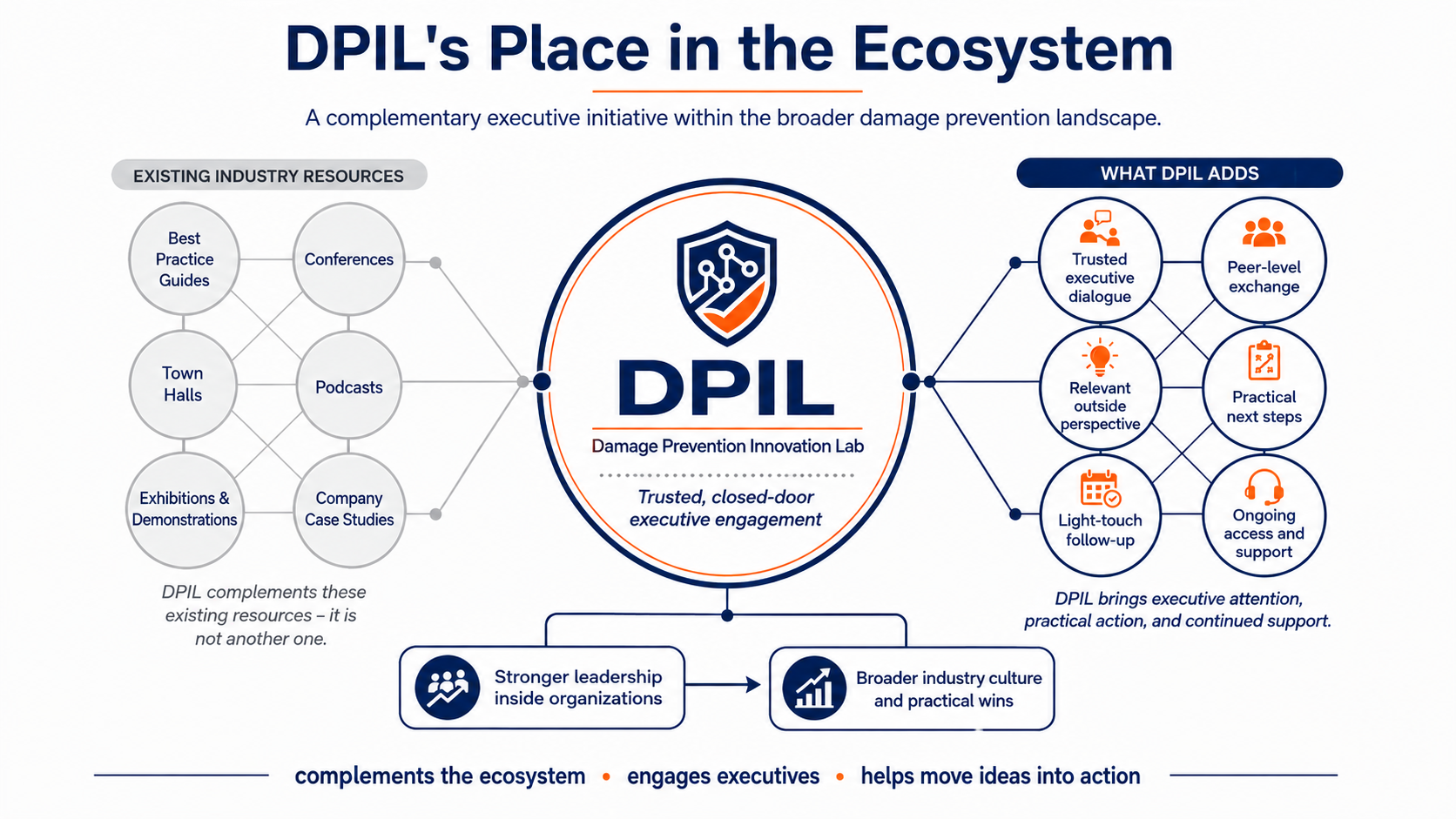
The Damage Prevention Innovation Lab (DPIL) brings CEOs and other senior decision-makers into direct, trusted engagement with the damage prevention industry.

Through candid, peer-informed dialogue, DPIL helps leaders strengthen culture from the top down, carry that leadership outward across stakeholder relationships, and translate executive attention into practical action, clearer accountability, measurable progress, and broader cultural influence across the damage-prevention ecosystem.

Contact roger@AligningChange.com to learn more.

Laptop and Phone

Share Your Thoughts

Give us your suggestions to help shape this concept.

DPIL Shield

DPIL Philosophy

Damage prevention culture must be led from the top – but it cannot stop inside one organization. DPIL is built around the belief that CEOs and senior leaders are uniquely positioned to shape expectations, allocate attention, direct implementation, model accountability, and influence the industry relationships where damage-prevention outcomes are actually produced.

Laws and enforcement can change behavior, but durable culture changes how leaders make decisions even when no one is forcing them to do so. DPIL helps leaders move from awareness to action – first setting their own house in order, then helping raise standards across the broader ecosystem.
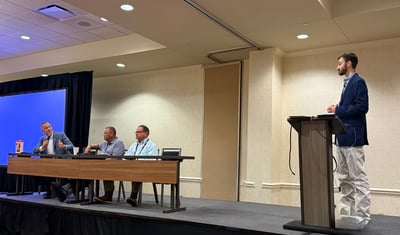

Making the C in C-Suite Stand for Culture
Reconciled Transcript
ACTS Now Global Damage Prevention Summit – Nashville, Tennessee – August 19, 2026

Benjamin Dierker, Aii  |  Ike Poe, New River Electrical Corporation  
Bill Turner, Tennessee811  |  Trey Crawford, Grady Crawford Construction

 
Benjamin Dierker
I look forward to introducing you all to this esteemed panel. I will get out of the way as quickly as I can after this question, but I want to thank everyone for being here. I know this is an important time for the industry to get together – a lot of handshakes, a lot of good business exchange, hopefully some good ideas to run home with today.
I am pleased to introduce a panel, “Making the C in C-Suite Stand for Culture.” My name is Benjamin Dierker. I am the executive director of the Alliance for Innovation and Infrastructure. We’re a think tank based out of D.C., so strictly speaking, I am not a damage prevention stakeholder, although I am pleased to share that I’ve just written a book with Scott Landes, who many of you may know, Holding Back Disaster.
It’s really a roadmap to the damage prevention industry and an explanation of who you are, what you do, and why it matters. It’s a great resource, so please find me after if you have any questions, and I would love for you all to get it for your teams.
But more importantly, I’m going to let this esteemed panel introduce themselves. We’re going to be talking about culture today, and not just culture in the abstract, but culture from the C-suite top down – what that means for damage prevention and how it can actually result in saving lives, protecting infrastructure, and making the whole operation that we care about better.
I’ll let you all start, if you don’t mind, by giving your name, where you are geographically, your stakeholder group – just kind of a little intro on who you are. Ike, why don’t you kick us off?

Ike Poe
Okay, thanks, thanks, Ben. Good morning, everybody. It’s nice to be with you here in Nashville, Tennessee. My name is Ike Poe. I am the president, CEO, chairman of the board of New River Electrical Corporation. New River is a high-voltage electrical utility contractor. We’re headquartered in Roanoke, Virginia. I come from Columbus, Ohio, where we have a large footprint as well.
We build power lines, we build substations, we build underground distribution systems, network systems, all across the country. We do about a billion and a half dollars of revenue a year. We employ over 2,700 folks at the moment, and we go coast to coast.
A unique piece of New River Electrical is we are 100 percent employee-owned. We’re an ESOP company. We’ve been in business for 73 years. It’s really good to be with you all this morning. Thank you.

Bill Turner
Good morning. I am Bill Turner. I am the president and CEO of Tennessee811, and I am located right here in Nashville. I’ve been in the industry for 39 years.

Trey Crawford
Trey Crawford with Grady Crawford Construction, secretary-treasurer. Third-generation business, underground utility construction. We primarily work in the Southeast U.S., but we really do any and all aspects of underground utility construction, from telecom, data centers, gas pipelines, petroleum lines. We do a lot of maintenance, sewer, water. Just pick something – we’ll stick it underground for you.

Benjamin Dierker
You guys represent a pretty decent cross-section of the industry, but also the country. It’s pretty broadly spread out. But what you have in common is that you’re all at the C-suite level of your individual companies.
I would love for you to give us a sense of what your day looks like, maybe your typical week. What does the C-suite – what does that mean? We hear it often. What does it really look like, your day in and day out? Is this an office job? Are you just looking at spreadsheets? Are you delegating 100 percent of things? What does the C-suite look like for you?
We’ll start with Ike again.

Ike Poe
Ben, great question. Of course, it depends, right? Our company is currently growing. Like I mentioned, we are an employee-owned company. We are highly marketable, so a lot of people want to buy us, right? A lot of people that do what we do have been acquired by conglomerates in the industry. So we’re very growth-minded. Being growth-minded will help us defend our independence.
So a lot of my day to day is focused on sales and business development and growing our company from coast to coast. I was very fortunate when I started this role. I’ve been with the company for 21 years, and when I moved into the CEO role a little over three years ago, I was very fortunate to have the opportunity to build my own C-suite, if you will, to build my team.
And what a wonderful opportunity that was. I knew these folks, I trusted these folks, they trusted in me, and most importantly, we believed in the overall mission and the overall goals of the corporation.
So my job is not so much hands-on day to day. I kind of laugh. I spent the most time in my career as a project manager. I was a very hands-on type of employee. I like to run projects and do things and get things done. And when you move into the CEO role, hell, I don’t do anything anymore. You know, that’s kind of the joke.
But you really focus on setting a vision. I appreciated that word being used so many times already this morning. You set the vision. You work with the board on a weekly basis to ensure the goals are aligned within this executive team, and then you let people do their jobs, right, and respond to daily or even weekly kind of crises throughout the organization.

Bill Turner
Oh, there is no typical day for me. They change daily. But I think I’ve had this question asked of me before, and I think what it comes back to is, one, understanding our mission and our core values, what we’re here to do, and making sure that we’re doing that every day.
Because we are in this safety business, certainly we’re striving to provide the safest service that we can, which also includes taking care of our employees. And that gets back to part of the discussion here – the culture, just making sure we’re doing right by our employees.
But what makes up most of my day, I think now, is I am a predictive personality-type person. I am always trying to predict what the future will hold, and so just trying to anticipate what’s next, what we need to be looking at in the future to be prepared for and to achieve, not only as an organization but also as part of our mission and how we serve our customers.

Trey Crawford
That’s pretty hard to follow up. But, you know, as you were saying, you’ve got a lot of downtime, and then you’ve got times where you are like, “Oh my God, everything just hit at once.” Dealing with insurance, there is always an attorney involved at some point.
But it’s the culture, and it gets back to the safety things. Damage prevention is as important in my job as somebody going home safe from a work comp, you know, not having to go get five stitches that cost $10,000. There is the whole aspect that you have to look after. You can’t say we’re going to have zero tolerance on automobile or vehicle accidents, but you can go cut up a gas line and that ain’t a big deal, you know.
And when you start micromanaging everything – and I am not a micromanager, but I am talking about safety-wise – you have an incident, we’ve got to have a meeting after that. How did this incident happen? Why? How could it be prevented?
And then you’ve got days where you get home and it’s like, “Honey, how was your day?” and you’re like, “I really didn’t do a whole lot today.” And then there are other days that are like, man, there just wasn’t enough time in the day.
I didn’t realize we had this until I got an email yesterday, and I told them I need to know about this within 24 hours. Well, dang it, then they told me we had three of them. So now I’ve got to get in here and be the bad guy and do the investigations.
And I’ve got a great safety manager that a lot of you guys know. There is a lot of stuff he shouldn’t be doing that the owner of the business needs to be handling. So there are a lot of hats, and it changes daily. It changes daily.

Benjamin Dierker
So it seems to me that culture is something that you really have to be on top of 24/7. If you let it lapse, people will change the culture. They’ll allow a corner to be cut or they’ll focus on something different.
Thinking about all the competing interests you have, Ike, you mentioned sales, aggressively trying to expand the business, maintain independence. That’s its own unique goal. How do you maintain a 24/7 safety culture? What does it look like in your context to emphasize a culture that actually prevents damage at the lowest level in the field when you’re up in the C-suite?

Ike Poe
Yeah, thanks, Ben. I mean, I think it really starts out with, from my seat, culture is not a thing; culture is the thing. If you think about driving a company forward, I’ll remind everybody, too, of something to be mindful of. If you don’t think about culture a lot, if you’re not focused on culture a lot, trust me, you have a culture. Even if you don’t think about it, you have a culture. It might not be the culture you desire to have, but you certainly have one.
So to me, that’s front of mind daily. And I think we can all agree, micromanaging – that’s certainly not our jobs. But it is very important to focus and be mindful of that culture daily, because if you are not, you are creating one that you may not desire to have.

Trey Crawford
And one thing that I have a different experience on is being a third generation. Once I became an owner, I had a lot of employees that I inherited. I didn’t hire them – you know, my dad did, his partner did. Once we became owners, we realized, okay, these folks aren’t going to make the cut. And they retired. You know, they knew they weren’t going to make the cut.
But it made our team and our culture so much stronger when our team members are going, “I’m glad he left.” And then you’ve got salespeople that are going, “Hey, how’s everything going since so-and-so retired?” Then you have customers that are going, “Man, these meetings are just a lot better than they were a couple of years ago.”
We’re like, “Yeah, it’s not as adversarial, wouldn’t you say?” And they’re going, “Yeah, this is actually a pleasure.” We’re going, “Well, we got rid of somebody that I inherited.”
And you have to look at your workforce. At least we did. We knew these people really weren’t going to fit in our culture, and they were part of the problem. And when you get rid of them, their coworkers – some of them are relatives – are going, “Glad you got rid of that guy.”
You know, it does. It changes. If you’ve got a bad apple in there and you get rid of it, and you go back and look a year and a half later at your retention rate, and everybody’s just pleased – I can’t believe it.

Bill Turner
Yeah, I think from a culture standpoint, in my eyes, there is no finish line. There are stages of success. There are markers that you put out there that you try to achieve. But if you’ve got a finish line when it comes to culture, you don’t have a good culture. You’ve got to keep pushing the limits.
You’ve got to, as you have success, challenge yourself and challenge your organization on what’s next. What can we do next to improve culture, or our business model, or our mission statement, core values? What can we do to continue pushing that finish line?
So, to me, when I think about culture, I’m never going to succeed at it because I’m always going to be pushing the limits. I’m always going to be wanting to do more and better.

Benjamin Dierker
Bill, I want to start with you on this question. So obviously, we’ve emphasized culture is never-ending. It’s something you have to constantly maintain. Like you mentioned, if you think you don’t have a culture, you do. It’s probably the wrong one.
Obviously, it’s something you have to maintain on your own team and your own organization from top to bottom. But have you seen any examples? Bill, I’m starting with you because you interface with all the other stakeholder groups more than everyone else. Obviously, Ike and Trey, you do on any job, clients and customers.
But Bill, from your seat, do you ever see examples where a positive culture that your organization has bled over to actually help with secure handoffs, help with actually improving the process when it interfaces with the next stakeholder group?

Bill Turner
I think that’s what I love most about my career in 811. Anybody can get behind safety. It’s easy, and it’s very infectious. As I have had a long career in this industry, one of my objectives is to surround myself with the best-quality people that I respect and have respect for. I think that’s what keeps me going – surrounding myself and building relationships with those people to do the best we can.
And again, those of us that are in the room that are connected to 811s, it’s a cult. You become so passionate about it, and you live and breathe it. It’s the best career I could have ever chosen for myself. I love every day of it. It’s going to be really tough for me to step away at some point in time, but it’s easy to get behind.

Benjamin Dierker
Same question, if either of you have an answer. I would also add in seeing a negative culture that bleeds out to the other groups, or a customer who’s got a bad culture, and that negatively impacts your team as you go to do the job.

Ike Poe
Yeah, it’s an interesting question, Ben. From my perspective, my mind wanders to – you know, we primarily work for investor-owned utilities. I’m sure a lot of you folks do around the country as well. And it’s fascinating to me, and it’s really a challenging puzzle to figure out.
As you bounce around to investor-owned utilities, some utilities prioritize safety differently, right? I mean, they all talk about safety, and I believe everyone has the best intentions. We don’t want to see people get hurt. But some prioritize safety very differently, and that’s a challenge for my company.
There is a cost typically associated with safety, with demanding and providing a safe working culture. There’s a cost to that. So that will test you, as some utilities are willing – or some customers; I shouldn’t single out my utility friends – but some customers of ours, whether they prioritize it or not, we cannot bend on our priorities and our goals and our overall culture.
Your employees, if you do – and we’ve been there; that has happened, speaking from experience – if you do, your employees or your crews or your folks, they see that. And then it really comes into question at the top of the organization: “Well, do you really believe in this safe culture that you’re talking about and you’re expecting from us?” Because if you say it one day and then bend on it the next day because the customer dynamic changes, it’s very visible to your folks.

Benjamin Dierker
Great. Trey, any thoughts?

Trey Crawford
We have very similar issues, and a lot of it is schedules and capacity. And look at the room I am talking to. When I have to go into a meeting and tell a client, “We can’t put any more drilling rigs in a market,” and they’re going, “Well, somebody’s going to,” we’re going, “The market won’t handle it. The municipality is at capacity.”
And they say, “We’re going to send six more crews in there.” We’re going, “That’s not going to turn out good. But this is your project. You do what you want.” And then the municipality shuts them down, and you hate to say, “I told you so.”
But you know what the market is. Look, we get paid by the foot. I would love to have 20 drills in a certain market. But I also know the pulse of the market, and I know that the locators are barely keeping up with us.
Sometimes you have to go back and tell your client the same thing: “Look, this market will not handle any more crews.” And they don’t know. They’ve got Wall Street pushing them, so they’ve got numbers to hit and they need so many passings. But at some point, when you are the boots on the ground, you are saying there is only so much we can do.
And that’s not what they want to hear. They want to hear, “Yeah, this guy will go give me more crews.” And if I am going to tear up the world, that’s not my goal. My goal is to give my client the best name possible, to keep them off Nextdoor apps and all that kind of stuff.
Everybody’s nodding your head. When I get on a Nextdoor app, guess whose fault it is? It’s mine. They don’t say the gas company mislocated eight services. They say, “It’s this guy over here tearing up the world.” So then you’ve got to manage that. That’s on the back end of it.
Then some days, we got a handwritten letter the other day from an elderly couple thanking us on what a good job we did. And I was like, “Well, this is a dying art form. Where are these people anymore?” But you get little successes like that.
It gets back to your culture and telling your people, “We’ve got to take care of these people.” It doesn’t matter what it’s called. We did it. We screwed up. We’ve got to fix it.

Benjamin Dierker
Let me pick up on that point about telling your people something. We retell a story in the book about seeing a crew that’s not wearing their protective gear. So the guy goes out to ask the crew and the owner, who’s on site, “Why aren’t they wearing it?” And he says, “Oh, you know, we’ve got the goggles and gloves in the truck, but they won’t wear it.”
And ultimately the owner is also not wearing it. So he’s not leading by example. Of course his crew is not going to wear it either. There is no expectation that they actually follow through.
Which leads me to this question: I bet there are some people in this room who resent their bosses, and I bet there are bosses who think that their team is ultimately kind of lazy. As the leader where the buck stops, and who’s expected to lead by example, set the culture, follow through – what do you do with that?
Help us diagnose both of those dynamics: people who are at the bottom thinking, “The C-suite doesn’t care. They don’t know what I’m facing,” and people who are at the top thinking, “They don’t understand that we have to deliver for the client. We have to keep things safe for the bottom line.” What do you do from the top?

Trey Crawford
You quit asking. You don’t say, “Please wear your PPE.” You tell them, “This is part of your job. If you don’t wear this, you can go work someplace else. You don’t have to work for us.” I don’t care.
And same with our subcontractors. We roll through subcontractors because if you are not doing it to our standards, you go find someplace else to work because you are just making us look bad.
I keep a hard hat and my vest in my truck, and I refuse to get out of my truck on a job site unless I am wearing it, because I don’t want anybody to say, “Well, you showed up to my site and you didn’t have your hard hat and your vest on.”
And I don’t get in the field enough. I probably put that stuff on maybe once a month. I should be doing it once a week. It’s important for me to get out in the field and see my people. They’re the ones that have told me, “Man, I haven’t seen you out in the field in a while. You should do it more.” And I’m like, “You know, you’re right. I really don’t.”
Look, I like being out of the office. Getting out in the field, it’s an important part. But the same thing – if I don’t wear my PPE, I am no better than anybody else.

Ike Poe
Yeah, I think this room really understands the idea of, “If you permit it, you promote it.” I think we all understand that now. And I agree, there really is a, “These are the rules; follow the rules.”
But what I find interesting in that mindset and in that conversation – and we talk about this a lot at my company – don’t confuse that with an expectation of perfection. That’s not at all what we’re asking of you as an employee. As a matter of fact, that’s not our goal. We are very imperfect people, right? And I think as leaders, we all need to acknowledge that. Hey, I screw something up every day.
I’m the lucky one because when I screw something up, it’s usually in front of a computer in a nice, comfy office. So, if you permit it, you promote it. Follow the rules. Do what we ask you to do. Follow the policy. But don’t confuse that with an expectation of perfection.
I think the key, really, in this area of building a safe working culture is, as we make mistakes, we have to learn from those mistakes. We have to communicate those mistakes, dissect those mistakes, and move on.
And I think if you embrace that culture, typically, most days, you have folks following the rules, trying to do the right thing. And then that, in turn, really kind of promotes this culture of, when we do make a mistake and just screw something up, we’re all going to learn from it and get better by it.
And really, whether it’s a near-miss program or a self-reporting program, that’s very helpful in your overall objective of providing a safe working environment.

Bill Turner
Lead by example. If you want them to do it, you’ve got to be willing to do it yourself. Reinforce good behavior, handle bad behavior. I think the key comes down to communication. You’ve got to be open and honest about it. You’ve got to be willing to share what your mission is, why you’re doing it, and just communicate.
When somebody’s not following the rules, you’ve got to find out why they’re not following the rules and make improvements on that.

Benjamin Dierker
Do you have a mechanism for teams lower than you to report things up to you that can ultimately improve the culture of the C-suite, if you’re not actually seeing it? You’re not going to be on site every time. What’s your mechanism for allowing things to come back up the chain?

Trey Crawford
Bill says communication. Communication – I mean, that’s what this whole industry is about. That’s what our whole culture is about. I told Mr. Rogers, “Somebody ought to have heard it.”
I’ve never been to a marriage counselor, but I always use this example: it’s like lying to your marriage counselor. If you go to a marriage counselor, or any kind of counselor, and you’re not being truthful and honest and communicating, you’re just spending money. You’re not getting anything out of it. It’s like attorney-client privilege. You better tell them everything.
And that’s the same with us in safety and culture. We show them what it costs when somebody needs five stitches. Had you worn your gloves, this could have been prevented. And then there are instances that it truly was just an accident and everybody did everything right.
But once we review that process and we go, “Bill, you did everything right. I’m sorry your foot’s in a cast, but this was just a freak accident. We’ve reviewed it, and this is where you’re at. What are you going to do different next time?” “Trey, I did everything right and I followed every checklist.”
Accidents do happen, but if you can learn from them and try to prevent it, that’s the biggest key takeaway, and then communicating that to everybody else.

Bill Turner
Create a safe space. Be approachable. I think if you want that upflow of information, you’ve got to be open and honest and be accepting of criticism. It may not be legitimate criticism, but it’s certainly somebody’s point of view.
There are some of my peers that may say that, well, Bill’s been in the industry for 39 years; he’s an expert. I am not an expert in 811. I’ve got a tremendous amount of knowledge. For me to accept the title of expert suggests that I know everything. I don’t know it. I’m always willing to learn and do more every day.
I’m confident that there’s somebody else, somebody out there, that has an idea or a thought that can make me better and make our company better. So just being open and honest with yourself, be willing to listen. Don’t tell people what to do. Get that feedback from people. That makes you better.

Ike Poe
Yeah, I think, Ben, in this question around how this gets reported up, I’ll just share a quick comment and story, I suppose. When we do have an incident, when something doesn’t go to plan, really the way I attack these things when it does get communicated to me is I have one very simple question every time. And it’s kind of simple language, I suppose.
Was this a “whoops” type of an honest mistake, like, “Boy, we just didn’t see something and we just dropped the ball”? Or was this a middle finger to safety? And I think that question really matters.
Number one, it depends how you respond to the client, and it depends on how you really tackle it internally, corporately, inside the company’s walls. And obviously, what I mean by a middle finger to safety – that answers, “Do we have a cultural problem?” Right?
If we just miss something – for example, if we’re 200 feet up in the air on a tower, working with conductor with 10,000 pounds of tension on it – you can miss something. You can miscalculate something. You can make those honest mistakes. Now, that’s a problem, but that’s a different problem than cowboying your way through and having a cultural problem to that.
So I think that’s the very first question we try to dissect in-house, because the cultural issue, quite frankly, is harder to fix than the “whoops, I made a miscalculation,” or “I forgot something,” or “I just missed something.”

Benjamin Dierker
So, on a practical question, assume a peer CEO comes up to you tomorrow from another organization and says, “What’s one practical way that I can improve my damage prevention performance this year?” Assuming the answer is not an email to your company or a new safety-minute type of program, what’s one practical action?

Ike Poe
My best advice I could give to a peer is, we call it BCD. You guys have heard this probably before. I think the one visible sign, as you’re dissecting a culture – and again, it’s not about perfection, it’s not about OSHA rates, it’s not about – I mean, that obviously all matters.
But I would look first inward and see if, within the company, do your leaders at any level of the organization, do they BCD? Do they blame, complain, and defend when things don’t go right? I think that is the first analysis that needs done.
Blaming, complaining, and defending is a cancer to your organization, and it’s particularly a cancer to a culture you’re trying to build. Things happen in what we do, right? We do very complicated and complex, very tough things. It’s risky work. It’s dangerous work.
As you have issues, if you own that risk, if you own your mistakes, you will get better. But if you blame, if you complain, if you defend against those bad days, it’s hard to move forward. That’s where I would start.

Trey Crawford
You know, the first thing I’d have to ask is, what’s their current culture like? If you are asking me how damages affect your profits, maybe you are not a very good CEO to begin with. I don’t know much about that.
These things cost money, and there is an effect to it. And it affects whatever division it happened in. That’s the other thing. Just because it happened in our sewer division, it still affects our communication side of the house. It’s not like, “Well, that doesn’t affect me.” It affects the whole company.
But if you don’t stay on top and manage damages – and I am talking about car wrecks, everything, work comp claims, and especially underground utilities – if you don’t care about all of it, I don’t know. It’s like having a shoe with half the shoelaces. You’ve got to care about all of it, or the shoe ain’t going to fit.
So it’s just an in-depth culture. That’s a tough question. But if you don’t care, that’s the biggest problem. You’ve got to care.

Bill Turner
I think it goes back to establishing the target. You’ve got to tell them what the target is. If they don’t know where they’re trying to go, how do they get there?
So, as a leader, I think you have to set the goal of, “This is where we want to be, and we’re not going to settle for anything less,” and make sure you consistently, constantly communicate what that target is and where we want to go as an organization.

Benjamin Dierker
This is my last question for everyone. As you think beyond your organization, what do you think is the most prominent opportunity for improving damage prevention culture across the ecosystem? Obviously, culture is where we’re grounding this discussion. How do you see culture as an opportunity for the broader damage prevention ecosystem?

Trey Crawford
That’s tough. I mean, all I can do is manage my own business, right? So we see competitors outbid you on a job, and you go by that job, or you have managers go by that job, and everybody’s telling you what they’re doing, what the competitors are doing wrong.
I can’t bid against that. I can only bid my number. And I know certain competitors are not going to have damage prevention like we are. They’re not going to have safety. They’re not going to manage their subcontractors like we are.
That’s up to our clients to figure that part out. I can only bid it how I know to do it safe and right. And if somebody else wants to undercut it, there is not much I can do about that.
So I just have to stay in my lane and hope that maybe events like this, another contractor is out there that is a peer and is going, “You know what? We don’t put enough emphasis on safety. We are kind of cowboys.” That’s the only hope I have.

Ike Poe
Well, I think it’s a great question, Ben. We’re doing a bit of a cultural shift around our safety program, and we all have priorities and goals, and that’s very important, to your point, very important to establish. But we’re starting to go down the path a little bit of trying to get away from safety as a priority, right? Just bear with me for a minute.
We’re really shifting our mindset to look at safety as a value. And not to make a play on words here, but if you really think about it, when you are chasing these numeric goals – whether it’s zero harm, and we had a zero-harm program forever and we have really good results from it – ultimately safety is a value.
First and foremost, it’s a value to the employee, right? Because they get to work their career, they get to make a living, they get to provide for their families. They get to do everything that each and every one of us is striving to do, safely, without getting hurt and without having an injury that will stick with them for the rest of their lives. That’s a tremendous value to the employee, if you think about it in those terms.
Secondly, it’s a tremendous value to the company, right? After all, we are a for-profit business with shareholders that we’re responsible for, and that’s important. We all understand the direct costs of accidents and getting people hurt. I mean, that’s pretty easy to calculate. But to build an injury-free culture that values safety and not just prioritizes safety, it’s incredibly valuable to the overall enterprise, right? Whether that’s through enterprise value, shareholder value, however you look at it.
So I think that’s a path we’re traveling down, and it’s challenging. It’s kind of scary, to be honest with you, to stop prioritizing numerical goals. And we’re going to have them. We still have them. Our customers demand them. But to really try to shift your mindset into a value creator for the employee and for the enterprise, it’s a very interesting thing.

Bill Turner
We had a famous legislator in Tennessee, Howard Baker, and one of his quotes that I use a lot is, “The other guy may be right.” And what that means to me is sometimes, if you just shut your mouth and listen and ask questions, you might find something out that can make it better.
But I think in trying to change culture, it’s a commitment on yourself. You have to commit yourself that this is what I am going to do. And once you make that commitment, be present. Be present. Make it a part of your objective to improve this. So listen, learn, and be present.

Benjamin Dierker
I like that. I think your point about removing safety as a priority and making it a value makes a lot of sense, because it removes the idea that you do safety or you do your culture, and then you move on to the next thing. It’s really something that pervades every step of every job and priority.
I want to thank you all for sharing your insights. Thank you all for listening. I now have the honor to announce a new initiative that Roger is spearheading with ACTS that I’d love for you all to be in the know about and ask questions about, and find me and Roger and others after.
This new initiative is called the Damage Prevention Innovation Lab, DPIL. The Damage Prevention Innovation Lab is going to be a C-suite-level executive advisory group. This panel is sort of a miniature foretaste of what that group can function as, but the goal is really to help and walk alongside C-suite-level decision-makers to actually improve safety and damage prevention culture.
This is going to be an ACTS initiative. So if you’d like to learn more, the best thing you can do is join ACTS, subscribe to the magazine and newsletter, and be on the lookout for new updates.
Thank you all three, and I’d love for you all to give these panelists a round of applause.

Roger Cox
Thanks, everybody. Our next session at 10 o’clock, and then one at 11, are going to be these concurrent breakout sessions.
pasagreen

Listen & Learn: PASA on the Podcast

PASA's Whitney Price joins the podcast to talk about the origins of PASA and how the association protects the agricultural community through education.