
Working around pipelines in water is not a new topic, but periodic reminders remain important for those who are involved with the work. They also provide helpful context for those who may be new to the task or industry.
Excavation work spans both on-land and in underwater environments, with submerged excavation including dredging, marine construction, spudding, and anchoring. Pipeline excavation applications may occur during the beginning stages of construction or extend to inspection, repair, or removal. Each phase presents unique risks across a range of environments, including marshlands, rivers, lakes, coastal waters and deepwater. Additionally, work may be conducted from barges or mud boats, adding another layer of work.
Before beginning any pipeline work in water, it is important to verify the location of the pipeline. Underwater pipelines can shift, and pipeline signs and markers can be displaced or removed by events such as weather, waves, boats, vessels, and erosion. Facility owners and operators can provide GPS coordinates (X, Y, Z coordinates, or KMZ/KML files) to locate a facility electronically (electronic marking is the preferred method for marine facilities). When electronic marking is not possible, physical markings can be used. These include buoys, cane poles, flags, nav-aids, reflective material, and PVC pipe.
Marine vs. Land Operations
Excavating on land differs significantly from excavating in marine environments. To inform the latter, the pipeline industry has created detailed guidance documents. For example, the Coastal and Marine Operators (CAMO) has published guidance documents, training resources, and checklists that address pre-excavation activities. Additionally, the Common Ground Alliance (CGA) has published a Best Practices on Marine Signage document and is developing separate information to address preventing marine damage.
Tolerance zones differ for land and marine operations, too. In land operations, they typically range from 18 to 30 inches on each side, with spoils being two feet back from the excavation edge.
In marine operations, the tolerance zone (also referred to as the marine exclusion zone), needs to be determined by all parties during the planning and risk mitigation process and is typically a minimum of 75 feet on either side of the pipeline. However, this guidance can vary depending on the marine environment, company procedures, and applicable state or federal regulations.
Locating Pipelines in State and Federal Waters
When performing any excavation in state waters, operators should begin by contacting 811 or the local One Call system. MarineSafe811 (marinesafe811.org) provides detailed information, including a map tool that allows users to select individual states for added guidance on their applicable 811 requirements.
Working in federal waters often requires additional planning to determine pipeline locations. The National Pipeline Mapping System (NPMS) can serve as a helpful resource, though excavators may need to take additional steps to determine pipeline locations. For instance, NPMS does not address the gathering or flow lines, distribution pipelines, or other utilities. In these instances, operators may look to state-level data, which may provide this critical information.
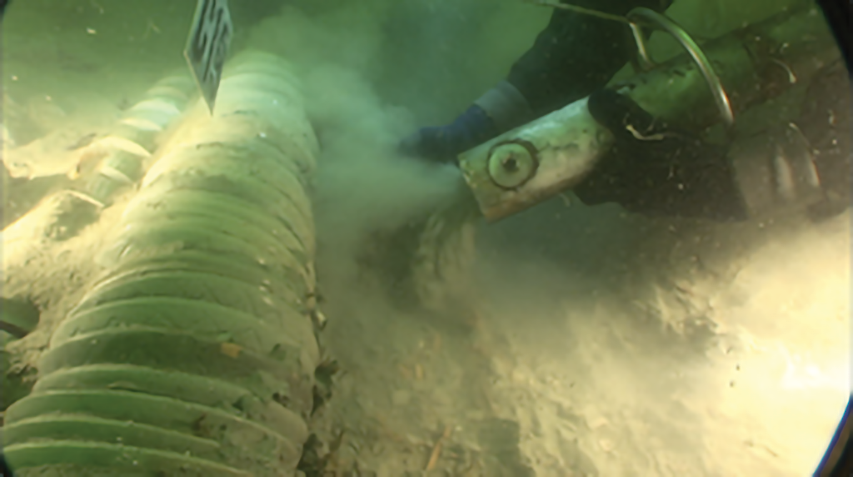
With proper training and specialized skills, divers can be indispensable for identifying accurate pipeline depths and locations for underwater excavations. However, it is critical they fully understand the scope of underwater activity work. Specifically, they need to be aware of the type of seabed conditions, their associated materials, and appropriate excavation techniques, such as hand jetting or using an air lift, based on the task, size of pipe, and seabed characteristics.
Operator Qualifications
The American Petroleum Institute’s (API) Operator Qualification Working Group (OQWG) for API Recommended Practice 1161, Pipeline Operator Qualification, collaborated with experienced divers from Phoenix International, who reviewed and created the OQ Tasks for several underwater procedures, including abnormal operating conditions (AOC). Engaging subject matter experts (SMEs) with deep knowledge and expertise in the tasks being performed, helped create the accurate and effective guidance.
Despite training, preparations, precautions, and lessons learned associated with working with pipelines in or around water, events still occur. Several are well-publicized, including the Marshall, Michigan, Kalamazoo River oil spill that took place in 2010, the Grand Rapids, Minnesota incident in 1991, the fatal Corpus Christi, Texas underwater pipeline strike and explosion in 2020, and the San Pedro Bay incident in California in 2021.
Pipeline Safety Management Systems
The National Transportation Safety Board (NTSB) investigates pipeline events in coordination with the U.S. Department of Transportation’s Pipeline and Hazardous Materials Safety Administration (PHMSA). At the latter’s request and to aid in the reduction of pipeline events, API published API RP 1173, Pipeline Safety Management Systems (PSMS) in 2015 (a revised edition is scheduled for publication later this year). RP 1173 provides a framework for pipeline operators to manage risk and improve safety performance following a plan-do-check-act cycle of continuous improvement and based on a robust safety culture.
As a companion measure to the publication of API RP 1173, API developed an assessment program to help operators assess, measure, and improve their programs, benchmark data, and collect leading industry practices. In 2024, it published guidance for the contractor community to clarify their role and advance their alignment with the operator’s PSMS.
Following a 2021 event in San Pedro Bay, in which two vessels dragged their anchors within a designated anchorage area, the NTSB conducted an investigation and held a public hearing. (NTSB Investigation: https://www.ntsb.gov/investigations/Pages/DCA22FM001.aspx). The Board subsequently recommended that operators develop and implement a PSMS based on API’s RP 1173, emphasizing competence, awareness, training, risk management, and continuous improvement. In 2024, PHMSA issued a report to Congress supporting the NTSB’s recommendation, followed by a PHMSA Advisory Bulletin and NTSB Safety Alert in 2025 emphasizing the benefits and importance of PSMS implementation.
Performing marine excavation work safely requires an understanding of both the commonalities and significant differences between on-land and submerged excavation, along with the necessary training and skills to protect workers, the public, and the environment. API and the pipeline industry continue to collaborate on best practices and guidance documents to ensure the safety of working on pipelines in water.