
Fiber optic networks form the communication backbone of our modern way of life. Whether we are streaming a movie, completing a credit card purchase, routing a 911 call, or transferring medical records between hospitals, there is a strong likelihood the information travels through buried fiber optic lines. Even though we commonly talk about “wireless” technology, the wireless part only applies to the last short connection to a device.
When a fiber optic line is damaged, the effects are felt immediately and can spread quickly. Interruptions can impact hospitals, airports, utilities, financial transactions, emergency communication centers, business networks, and entire communities. Protecting fiber infrastructure is a shared responsibility for engineers, utility owners, contractors, and locating technicians.
For locating purposes, the technician should first know if the fiber is armored with metallic shielding or unarmored without any type of metal built into the cable. If non-metallic, a locator is searching for a tracer wire somewhere in the splice box or housing. If there is not a metallic wire installed, the fiber is unlocatable by EM pipe and cable locating devices. This is because detection equipment applies an alternating signal current either directly or indirectly using signal induction methods.
A signal transmitter, which is a small alternating current generator, is either directly or indirectly attached to a buried conductor and vibrates electrical current back and forth on it at a set frequency. The vibrating electricity creates a detectable electromagnetic signal wave vibrating at the same frequency. The product or service provided by the cable or pipe is not relevant when it comes to locating the facility. If it’s a metallic conductor we can trace it by using electrical pulses. If there is no metal, we cannot.
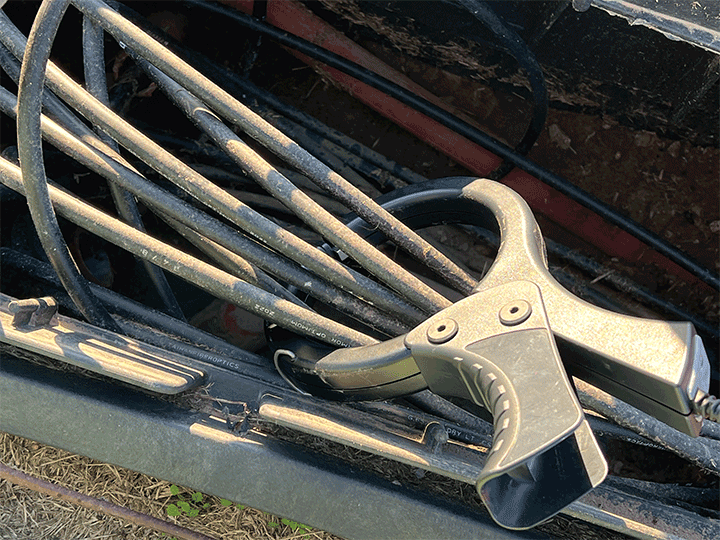
Often times fiber is looped through but not spliced in the pedestal or vault. Without direct access to the fiber cables shielding, a locator may indirectly apply signal current to the shield of the cable by using an induction ring clamp. For maximum induction, a technician often loops the ring clamp around the fiber loop to build a miniature amplifier.
Non-Locatable Fiber: When No Metal Means No Signal
Many direct-buried fiber optic cables contain no metallic components. Unlike copper cables or steel pipelines, fiber does not conduct electricity. Electromagnetic locating equipment works by transmitting a signal through a conductor and detecting the magnetic field that signal produces. If a direct-buried fiber cable does not have metallic armor or a tracer wire installed with it, it is non-locatable using electromagnetic locating equipment. There is no conductive pathway for the signal to travel along and therefore nothing for the locator to detect from the surface.
In these cases, surface locating is not possible. The fiber can only be confirmed by visual exposure, referencing accurate mapping records, or locating electronic markers if they were installed during construction. Many older fiber routes were installed without tracer wire or marker systems, which creates uncertainty when excavation is planned later.
A few tips when fiber is buried
parallel with metal pipes along a utility easement or right-of-way:
- If direct connecting, place ground away from other lines in the right-of-way.
- Use a ring clamp which isolates the signal current between the grounding points of the cable.
- If there is a tracer wire leaving in both directions, clip the red lead to one wire and the black connection lead to the other wire. Inline connection does not require the use of a ground connection and is a valuable approach when in areas where there is not a connection to earth
Fiber Signal Confusion and Distortion Near Steel and Iron Pipes
Another challenge arises when fiber is placed parallel with steel or cast iron pipes in the same right-of-way. In congested rights-of-way, fiber is frequently installed beside gas mains, water lines, or sewer infrastructure. Those large metal masses can provide a better pathway for applied signal current. Often times, when applying signal current to a tracer wire or ungrounded fiber shielding, the locator applies a signal to it and the signal may leave the fiber and travel along the nearby steel pipe because steel provides an easier electrical path.
When this happens, the technician may trace and mark the wrong utility without realizing it. The marks may appear clean and consistent, yet they are misleading. Excavation crews may believe they are digging safely, only to find the fiber in the path of their bucket. This type of locating error does not stem from carelessness, it stems from the natural behavior of electrical current in the presence of larger metal utilities.
Metallic Armor Requires Adequate Grounding
Some fiber optic cables include metallic shielding or armoring for physical protection. While this metal can be used to conduct a locate signal, it is only effective when it is consistently bonded and grounded. Poorly grounded cables represent resistance to current flow which limits the strength of the detected signal and the distance and depth it can be traced.
Most shielded fiber cables are grounded at each splice which gives the locator direct access for direct or indirect signal current application.
Each of the cables has a ground wire leaving the splice case and sharing a bond at the ground connection bar. A cable clamp is used to induce signal current to the well-grounded cable. Cable clamps are a valuable accessory when isolating a single fiber cable in a congested utility easement. Good grounding helps increase the effectiveness of the equipment and accuracy of the mark.
Tracer Wire Size Affects Locating Success
When tracer wire is used, its size matters. The larger the gauge of wire, the greater the amount of detectable current we can apply to the conductor. A very small gauge tracer wire has high electrical resistance and therefore carries only a weak locating signal. A stronger, thicker tracer wire has greater capacity of current which allows the locator to detect the fiber’s route at greater distances and depths. If a fiber route is critical to communication or public safety, the tracer wire chosen during installation should reflect that level of importance. A thin tracer wire may be less expensive to install but may significantly complicate locating tasks throughout the life of the fiber.
Locating devices are designed to locate the center of a round signal field. If the field is not round, the equipment will be in error. In cases where the cable conduit has a wire embedded or infused into the poly pipe, verify the wire is round and not a square.
A signal wave takes the shape of the conductor. In cases where the cable conduit has a square tracer wire attached, the radiating signal wave will also be square which creates erroneous readings of the signal at the surface.
Congested Utility Easements and Deeply Installed Fiber Add Another Layer of Difficulty
In many areas, fiber is installed deep to avoid conflicts with other utilities. The deeper a cable is buried, the weaker the surface-detectable signal becomes. Soil composition, moisture, and the presence of other utilities can further distort or weaken the signal. In such cases, locating may produce a wide or unfocused response, making it harder to identify the exact centerline and depth. Verification through potholing is often necessary to confirm the fiber’s position before excavation proceeds.
Access Points Influence Locating Accuracy
Finally, the ability to locate fiber depends heavily on access. To apply a locating signal, the technician must connect to the tracer wire or the cable shielding attached to the grounding system at a handhole, pedestal, vault, or building entry. These access points are not always located near the excavation site. When the signal must travel a long distance from the transmitter, it naturally weakens. By the time it reaches the area where digging will occur, the signal may be too faint to rely upon confidently.
A Better Approach Moving Forward
All of these fiber locating challenges point to an essential truth: the locatability of an underground utility is determined during planning and installation. The decisions made when placing fiber cable in the ground, including whether to include tracer wire, how to size it, how to bond cable shielding or tracer wire, where to place access points to buried cables, and whether to record and mark the exact route accurately, directly affect the ability to locate fiber in the future.
When fiber is installed with future locating in mind, we reduce risk and protect communities. Do not waste an opportunity to record a GPS point or any other cable location data. Every repair, every exposure, and every upgrade provides an opportunity to improve how easily that fiber cable can be located.